

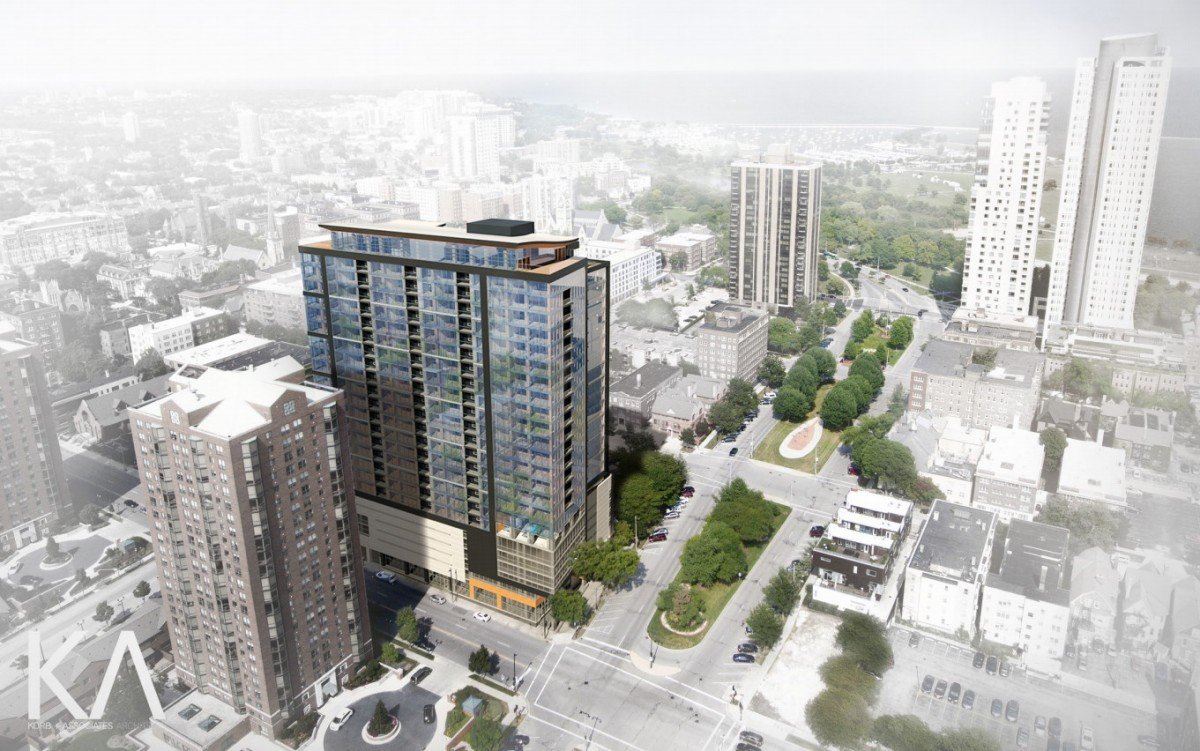
Milwaukee’s proposed 25-story Ascent Tower sounds like a conventional housing project. Construction is scheduled for September 2022 and offers over 250 apartments with great views of downtown Milwaukee and Lake Michigan. But one thing distinguishes it from other residential towers in the USA – it is said to be the tallest wooden tower in the world.
Why wood?
Timber construction companies believe that compared to typical building materials such as steel and concrete, wood is easier and cheaper to process and more durable in the long term. Best of all, it could be good for the environment.
“Solid wood construction” [a method of using timber for construction] requires 90% less site traffic, 75% fewer workers on site and is 25% faster than traditional construction. All of these reductions contribute to reduced emissions related to the construction process, ”Tim Gokhman of New Land Enterprises, the team behind the Ascent Tower, told NextCity.
While the use of wood construction to save the environment sounds contradictory, in recent years more and more wood constructions that were built in the USA have proven the opposite.
Building is usually one of the largest sources of CO2 emissions. According to the latest Global Status Report, building and construction are responsible for more than 35% of all CO2 emissions worldwide, 40% in the United States. It is estimated that this number will almost double by 2050, as millions of residential and commercial buildings are built every year.
To combat such construction emissions, real estate developers and construction companies rely on wood to store carbon and enable sustainable housing projects. How it works, explains Erica Dodds, CEO of the Foundation for Climate Restoration: “Trees remove carbon dioxide from the atmosphere. When trees are then converted into solid wood for construction, the carbon is “locked” in the buildings for decades or even centuries and the amount available in the atmosphere is reduced. “
In addition to removing carbon from the atmosphere, “solid wood also helps builders avoid emission-intensive building materials such as concrete and steel,” adds Dodds. “Solid wood construction could help us avoid between 14% and 31% of the world’s annual emissions by avoiding the emissions that would result from using concrete or steel in construction.”
Take the Milwaukee Ascension Tower, for example. “By using solid wood, Ascent is using a renewable resource,” says Gokhman of New Land Enterprises. “Sustainable forestry is the foundation of the mass timber movement, and it is estimated that it would take only 25 minutes of natural growth in North American forests to replenish the timber [buildings like] Ascent will benefit. “
Some proponents suggest that well-managed wood procurement can actually benefit the environment. “With careful forest management, sustainable timber harvesting can preserve forest biodiversity and resilience and make them less vulnerable to pests and forest fires,” says Dodds. “These emission savings can more than offset the risk of less CO2 being captured by the forests.”
For these reasons, timber construction has been popular in European cities for years, and North America is now catching up. Today there are 1,114 large-scale solid wood residential and commercial projects in the United States. Many of them are residential projects that offer a sustainable alternative to traditional steel construction.
For example, Vancouver has a wooden college dorm, Cleveland, Ohio has proposed a nine-story solid wood apartment complex, and Brooklyn, New York has Frame Home.
In addition to an environmentally friendly living alternative, solid wood construction offers a multitude of safety and durability advantages.
“The data shows that solid wood works just as well or even better than other building materials in fire, earthquake and wind. In fire tests, solid wood panels char on the outside and form an insulating barrier that protects the wood inside, ”said Gokhman.
Weight is another important factor to consider when building high-rise buildings, Gokhman adds. “Cities all over the world are actually slowly sinking. Years of urban development, taking into account the weight of a building but not the weight of a block, has contributed to a geological phenomenon known as land subsidence. ”
Timber construction can help here. Using their Ascent project as an example, they add: “Since Ascent weighs about 1/5 the weight of a concrete building of the same height, we can increase the population density with a smaller footprint.”
If timber construction is so beneficial, why doesn’t everyone do it?
While wooden buildings offer a variety of industrial and environmental benefits, some concerns have not yet been fully addressed.
First, timber construction uses a lot of trees and there is little guarantee of officially monitored and ethical timber procurement. It can be an economic, ethical and legal minefield to find enough wood for such large-scale construction projects without endangering the current wood forests. And right now, with climate risks increasing, even a small percentage of bad players can pose a serious threat to the environment.
Another problem for timber construction developers was the International Building Code (IBC), which restricted the construction of tall timber buildings for safety reasons. “Conducting the necessary research and obtaining permits was a two-year process for Ascent as the building will exceed the historic height limit for a wooden structure by around 60 meters,” says Gokhman. “There was no US precedent or roadmap to follow when it came to development, finance, insurance or procurement.”
Fortunately for wood developers, the code has now been changed to make wood buildings up to 18 stories high, which could explain the recent boom in wood construction. “The [updated] code will better enable the design and construction of tall, solid wood buildings up to 18 stories tall (up from 6 previously), ”said Will Gulliver, director of Turner & Townsend, a global real estate development and consulting firm that recently started work on Wood projects has started.
There is also a problem of awareness. Many builders have not considered timber construction just because they do not know that there is such an environmentally friendly alternative to steel and concrete.
So even the developers at Ascent did not initially realize the advantages of timber construction. “Our team was drawn to wood because of its beauty and the innate benefits of creating spaces that use natural elements,” Gokhman told NextCity. “We discovered the innumerable environmental benefits of solid wood construction when we had already started working on the project.”
Yet despite these difficulties, experts like Gokhman, Dodds and Gulliver agree that the benefits of properly executed timber construction can far outweigh the problems. If awareness grows and the obstacles subside, it is possible that other countries will adopt timber construction as an environmentally friendly alternative to concrete and steel construction. “The supply and engineering expertise of solid wood in North America is improving and this will be the development and use of [timber construction] in most cities. “
Comments are closed.