

Proteins in human saliva make up its proteome and could be the key to new medical precision diagnostics that would give clinical pathologists new ways to identify diseases
Clinical pathologists may soon have a range of new precision medicine diagnostic tools based on human saliva. There are more and more “–ome” that can serve as a source of useful diagnostic biomarkers for the development of clinical laboratory tests. The latest is the world’s first salivary protein biome wiki.
The “public data platform” created by researchers at the University of Buffalo is known as the Human Salivary Proteome Wiki (HSP Wiki) and, according to Labroots, is the “first of its kind” and “contains data on the many thousands”. of the proteins present in saliva. “
The HSP Wiki brings together data from independent studies on proteins in human saliva. One of the researchers’ goals is to accelerate the development of saliva-based diagnostics and personalized medical instruments.
In The Human Salivary Proteome Wiki: A Community-Driven Research Platform, published in the Journal of Dental Research, the researchers wrote, “Saliva has become an attractive body fluid for on-site, remote, and real-time monitoring of oral and systemic health. At the same time, the scientific community needs a saliva-centric information platform that can keep pace with the rapid accumulation of new data and knowledge by annotating, refining, and updating the saliva proteome catalog.
“We developed the Human Salivary Proteome (HSP) Wiki as a public data platform for researching and retrieving individually curated data and knowledge about the salivary proteome. … The HSP Wiki will pave the way to exploit the full potential of the salivary proteome for diagnosis, risk prediction, therapy of oral and systemic diseases and preparation for emerging infectious diseases, ”they concluded.
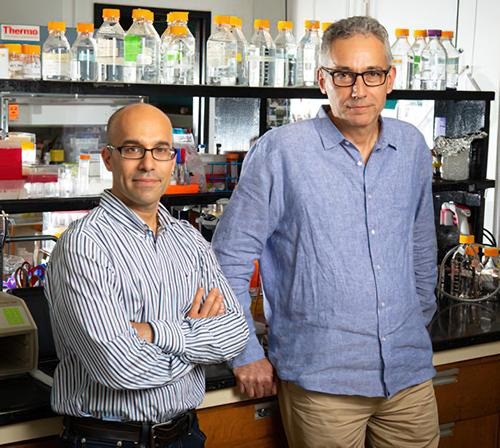
“This community-based database of data and knowledge will pave the way for the full potential of saliva Proteome for diagnosis, risk prediction and therapy of oral and systemic diseases and to increase preparation for future emerging diseases and pandemics. Stefan Ruhl, DDS, PhD (top right, with Omer Gokcumen, PhD, Associate Professor of Biological Sciences (left), Professor, Department of Oral Biology, University of Buffalo, and lead researcher on the study, told Labroots. The development of precision medical clinical laboratory diagnostics is one of her research goals. (Photo Copyright: University of Buffalo.)
Where does saliva come from?
Saliva is a complex biological fluid that has long been associated with oral and upper gastrointestinal health. However, scientists have only recently begun to understand where the salivary proteins in the body come from.
Researchers in a study published in Cell Reports, entitled Functional Specialization of Human Salivary Glands and Origins of Proteins Intrinsic to Human Saliva, sought to better understand the sources of saliva.
The authors wrote, “Salivary proteins are essential for maintaining health in the oral cavity and proximal digestive tract and serve as potential diagnostic markers for monitoring human health and disease. Their exact organ origin, however, remains unclear.
“Through the transcriptomic analysis of the most important adult and fetal salivary glands and the integration with the salivary proteome, the blood plasma proteome and transcriptomes of over 28 organs, we link human salivary proteins with their source, identify genes specific to the salivary gland and uncover fetal and adult-specific gene repertoires,” added she added.
“Our results pave the way for future studies on glandular biology and pathology, as well as the use of saliva as a diagnostic fluid,” the researchers concluded.
Saliva plays a vital role in digestion by breaking down starch. It also provides a protective barrier in the mouth. If the salivary glands malfunction, patients can have serious health consequences. While clinicians and scientists have long understood the importance of saliva for good health, the question now arises as to whether it contains markers for certain diseases.
“The Human Salivary Proteome Wiki contains proteomic, genomic and transcriptomic data as well as data on the glycom, sugar molecules present on salivary glycoproteins. New data is directed by an interdisciplinary team of curators who ensure that all input data is accurate and scientifically sound, ”noted Labroots.
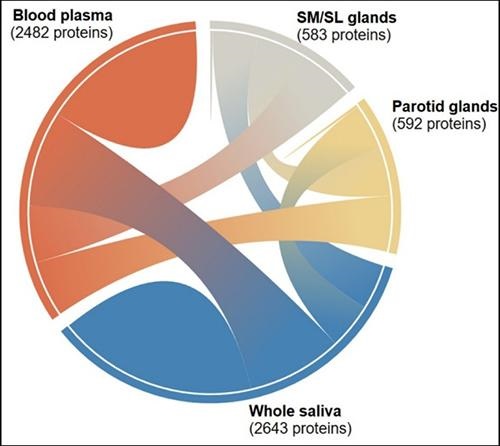
The graphic above “shows the interlinking of the thousands of salivary proteins that come from blood plasma, Parotid gland, and Lower jaw and sublingual glands. The diagram is one of many tools available to researchers and clinicians through the Human Salivary Proteome Wiki, ”noted a UBNow blog entry. (Graphics Copyright: University of Buffalo.)
Omics and their role in clinical laboratory diagnostics
Proteomics is just one of several hotly researched omics that have the potential to become essential personalized medical and diagnostic tools for pathologists. Genomics is a related research area that is being investigated for its potential for precision medical diagnostics.
However, unlike genomes, which do not change, proteomes are constantly changing. This is one of the main reasons why studying the human salivary proteome could lead to valuable diagnostic tools.
By combining the study of the ome with tools such as mass spectrometry, a new era in pathology could emerge. “With the rapid decline in the cost of omics technologies in recent years, profiling the entire proteome of tissue supports has become more accessible to diagnostic laboratories as a means of characterizing global protein expression patterns for assessing the pathophysiology of disease,” noted Pathology News.
Saliva and the Age of Precision Medicine
Studying the -ome can be an important element in the development of precision medicine as it can provide information about what is happening in the patient’s body at the point of care.
In Precision Medicine: Establishing Proteomic Assessment Criteria from Discovery to Clinical Diagnostics, study authors Jennifer E. Van Eyk, PhD, Director of the Advanced Clinical Biosystems Research Institute in the Department of Biomedical Sciences, and Kimia Sobhani, PhD, Director, ER and Cancer Center Laboratories and Associate Professor, Pathology and Laboratory Medicine, at Cedars-Sinai Medical Center, wrote, “The central goal of precision medicine is to provide the right treatment to the right patient at the right time based on their unique diagnosis / pathophysiological signature. Success depends on the development of high quality biomarkers that aid in the diagnosis, prognosis and risk stratification of each patient. “
Hence, a thorough understanding of the salivary proteome and its changes in response to various health conditions and diseases could open the door to an entirely new branch of diagnostics and laboratory medicine. It is easy and non-invasive to collect, and given that saliva contains so much information, it offers an opportunity for studies that can improve patients’ lives.
It would also bring us closer to the age of precision medicine, where clinical laboratory scientists and pathologists can add even more value to referring physicians and their patients.
—Dava Stewart
Related information:
The Human Salivary Proteome Wiki: A Community Driven Research Platform
Functional specialization of human salivary glands and origin of proteins that are intrinsic to human saliva
Researchers create the first saliva wiki
Precision medicine: definition of proteomic evaluation criteria from discovery to clinical diagnosis
Comments are closed.